The Tahoma Clinic Discovery: Why Age-Related Low Stomach Acid (And Antacids Like Omeprazole) Stop Vitamin D3 Pills From Absorbing After 50
If you are over 50, faithfully swallowing a Vitamin D3 and calcium capsule every morning, yet your annual blood test still shows sluggish 25(OH)D levels—or your bone density scan continues to slip—the culprit is rarely the dose printed on the bottle. According to three decades of clinical testing by Dr. Jonathan V. Wright, M.D. at the Tahoma Clinic, the bottleneck happens inside your stomach before the pill ever reaches your bloodstream.
1. The Age-50 Gastric Acid Cliff (Hypochlorhydria)
Most adults assume that stomach acid remains constant throughout life—or that heartburn means you have too much acid. Clinical gastro- capsule measurements show the exact opposite: human hydrochloric acid (HCl) and pepsin output peak in our twenties and decline steadily after age 40.
"Contrary to popular belief, stomach acid secretion tends to decline with advancing age... Atrophic gastritis affects more than 30 percent of people over the age of sixty. As stomach pH rises, the complex and finely tuned digestive and absorptive processes get thrown out of balance. As a result, many vitamins, minerals, and other nutrients destined for transport across the intestinal lining and into the bloodstream literally 'miss the boat' and wind up exiting the body."
— Dr. Jonathan V. Wright, M.D. & Lane Lenard, Ph.D., Why Stomach Acid Is Good for You, pp. 22, 62Even more startling, when Dr. Wright measured stomach pH directly in patients over age 40 complaining of indigestion, heartburn, and bloating, over 90% actually produced inadequate stomach acid (p. 78).
2. The Cholecystokinin (CCK) & Bile Chain Reaction
Why does low stomach acid ruin the absorption of fat-soluble vitamins like Vitamin D3 and Vitamin K2? On page 52 of Why Stomach Acid Is Good for You, Dr. Wright maps out the upstream chain reaction that most supplement makers ignore:
- Step 1 — Binder Disintegration: Hard compressed tablets and thick gelcaps require an acidic gastric pH (1.5 to 3.0) to break apart microcrystalline cellulose, magnesium stearate, and shellac coatings within the 30-to-45-minute gastric transit window.
- Step 2 — The CCK Bile Trigger (p. 52): When properly acidified food leaves the stomach and enters the duodenum, that acidity triggers the release of the hormone cholecystokinin (CCK). CCK travels to the gallbladder and commands it to release bile—which is mandatory to emulsify fat-soluble Vitamin D3 and K2.
- What Goes Wrong After 50: When stomach acid is weak (or suppressed by acid blockers like Omeprazole/Prilosec, Nexium, Famotidine, or calcium carbonate antacids like Tums), the tablet fails to fully disintegrate and the CCK bile signal is blunted.
The "Tums Trap" for Bone Health (Wright, p. 28)
Dr. Wright highlights a tragic irony on page 28: millions of older women chew calcium carbonate antacids (like Tums) hoping to protect their bones from osteoporosis. Because calcium carbonate is an alkaline chalk that neutralizes hydrochloric acid, it actively shuts down the very stomach acid required to absorb calcium and trace minerals—leaving bones starved while unguided calcium circulates in soft tissue.
3. Why 3-Second Sublingual Strips Bypass the Pill Bottleneck
When you place a NordicMelt™ D3 + K2 Oral Dissolving Strip on your tongue, there is no compressed chalk tablet to dissolve, no gelatin shell to break down, and zero water required:
- Pre-Dissolved Sublingual Film: Melts completely in 3 seconds across the highly vascularized oral mucosa of the tongue and inner cheek.
- Paired With 120 mcg Vitamin K2: While 2,000 IU of Vitamin D3 supports healthy serum vitamin D levels, 120 mcg of Vitamin K2 activates osteocalcin to lock calcium into bone matrix.*
- Free Bonus Monograph Included: Every 90-Day (3-Tin) and 150-Day (5-Tin) bundle includes our complete 4-page clinical PDF monograph, The Calcium Paradox & Sublingual Absorption 50+ Protocol (Download Free Preview PDF).
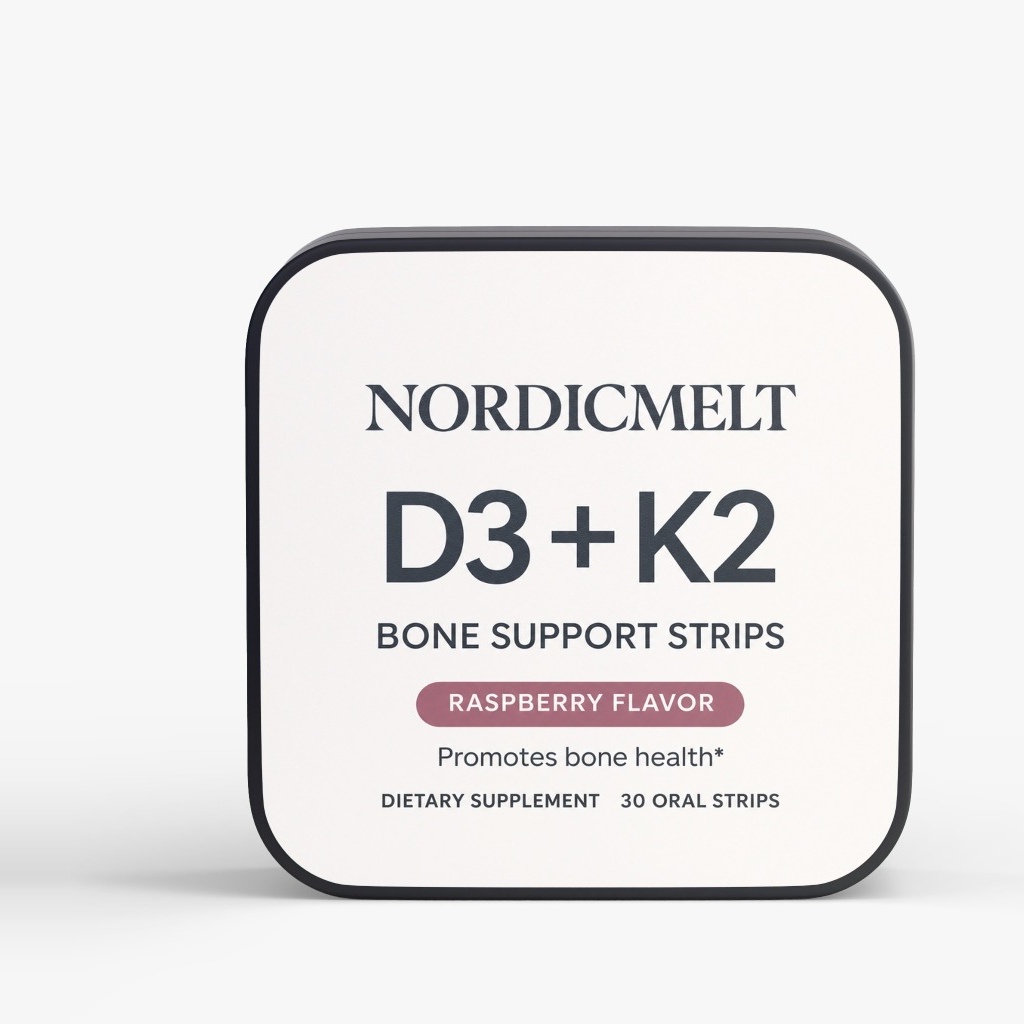
Ditch Chalky Horse Pills for the 3-Second Nordic Strip
Experience effortless sublingual bioavailability in a pocket-sized matte-black metal tin—backed by our 90-Day Bone & Energy Guarantee.
Try the 90-Day D3 + K2 Reset (Save 35%) →