Vitamin K2, Osteocalcin & The Rotterdam Study: Why 120 mcg Daily Is the Missing Partner to Vitamin D3 After Age 50
Walk down any pharmacy aisle and you will see dozens of standalone Vitamin D3 bottles claiming to build strong bones. Yet in her landmark clinical book, Vitamin K2 and the Calcium Paradox, naturopathic physician Dr. Kate Rhéaume-Bleue reveals why taking Vitamin D3 without Vitamin K2 leaves the body's calcium-routing machinery half-finished.
"Although vitamin D is crucial for calcium absorption, it has no effect on what happens to calcium once it is absorbed. That role belongs to K2... Vitamin K2 activates osteocalcin, which attracts calcium into bones and teeth, and activates matrix Gla protein (MGP), which sweeps calcium out of soft tissues like arteries and veins."
— Dr. Kate Rhéaume-Bleue, B.Sc., N.D., Vitamin K2 and the Calcium Paradox, pp. 24, 1171. How Gamma-Carboxylation Unlocks Osteocalcin & MGP
When you take 2,000 IU of Vitamin D3, it signals your bone-building cells (osteoblasts) to manufacture a specialized protein called osteocalcin—the second most abundant protein in human bone after collagen (p. 26). However, freshly made osteocalcin is undercarboxylated (inactive). Without Vitamin K2 to perform a biochemical reaction called gamma-carboxylation, osteocalcin cannot bind calcium ions.
At the same time, Vitamin K2 activates Matrix Gla Protein (MGP) inside your blood vessel walls. As Dr. Rhéaume-Bleue documents on page 28, "Vitamin K2-activated MGP is the strongest inhibitor of tissue calcification presently known."
2. The Rotterdam Study (4,600+ Adults) & Hip Fracture Data
Is dietary Vitamin K1 from spinach or kale enough to activate osteocalcin and MGP? On pages 33 and 107, Dr. Rhéaume-Bleue cites the landmark Rotterdam Study (Journal of Nutrition, Geleijnse et al.), which tracked over 4,600 adults aged 55 and older:
- 52% Lower Aortic Calcification: Participants with the highest intake of Vitamin K2 (menaquinone) experienced a 52% reduction in severe aortic calcification and a 41% lower risk of coronary heart disease (p. 107).
- Vitamin K1 Had Zero Cardiovascular Effect: Even high intakes of leafy-green Vitamin K1 (phylloquinone) failed to protect arteries because the liver retains K1 for blood clotting rather than distributing it to bones and blood vessels (p. 33, 47).
- 65% Hip Fracture Difference (p. 122): A separate cohort of nearly 900 older adults found that those with the lowest Vitamin K2 status had a 65% higher risk of hip fractures than those with the highest levels.
3. Why 120 mcg Daily Beats Hard Tablets (Pages 89–92)
On pages 89–92 of Vitamin K2 and the Calcium Paradox, Dr. Rhéaume-Bleue explains two critical rules when choosing a K2 supplement:
| Clinical Criteria | Synthetic MK-4 Hard Tablets | Long-Chain K2 (120 mcg Sublingual Strip) |
|---|---|---|
| Biological Half-Life (pp. 89–90) | Short (1–2 hours; requires 45,000 mcg split 3x/day) | Sustained 24–72 Hour Activity (once-daily dosing) |
| Clinically Validated Daily Dose (p. 92) | Ineffective at low microgram doses | 120 mcg / day (carboxylates osteocalcin steadily) |
| Delivery Vehicle (p. 92) | Hard compressed tablet ("Avoid hard tablets" — p. 92) | 3-Second Sublingual Oral Dissolving Strip |
Notice Dr. Rhéaume-Bleue's explicit advice on page 92: avoid hard compressed tablets for fat-soluble K2 and D3. NordicMelt™ D3 + K2 Bone Support Strips deliver the exact 120 mcg Vitamin K2 + 2,000 IU Vitamin D3 clinical ratio in a 3-second wild raspberry tongue strip—and every 3-Pack or 5-Pack includes our downloadable Calcium Paradox 50+ Protocol PDF Monograph.
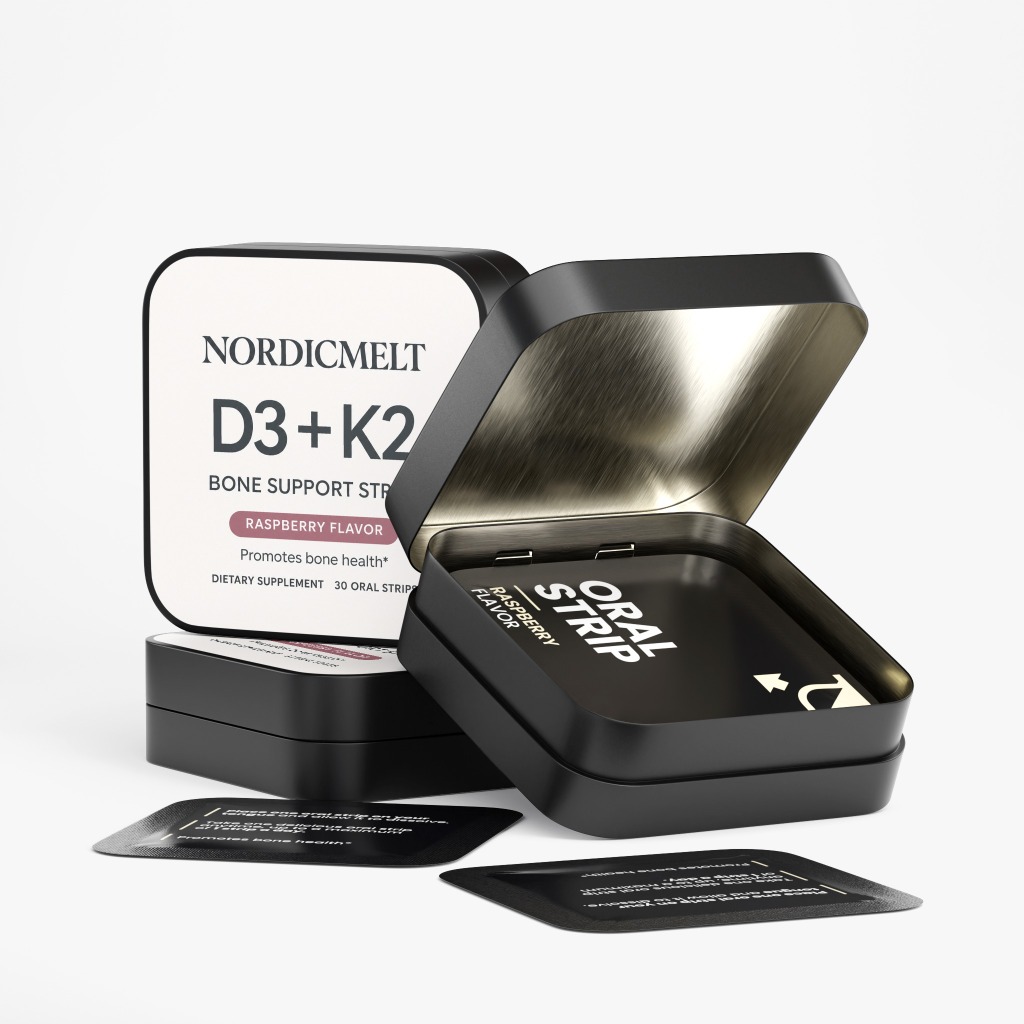
Activate Your Osteocalcin in 3 Seconds a Day
Zero chalky pills, zero water, and zero sugar. Includes our 4-page Calcium Paradox 50+ Protocol PDF free with every 90-Day Reset bundle.
Shop NordicMelt™ D3 + K2 Strips →